
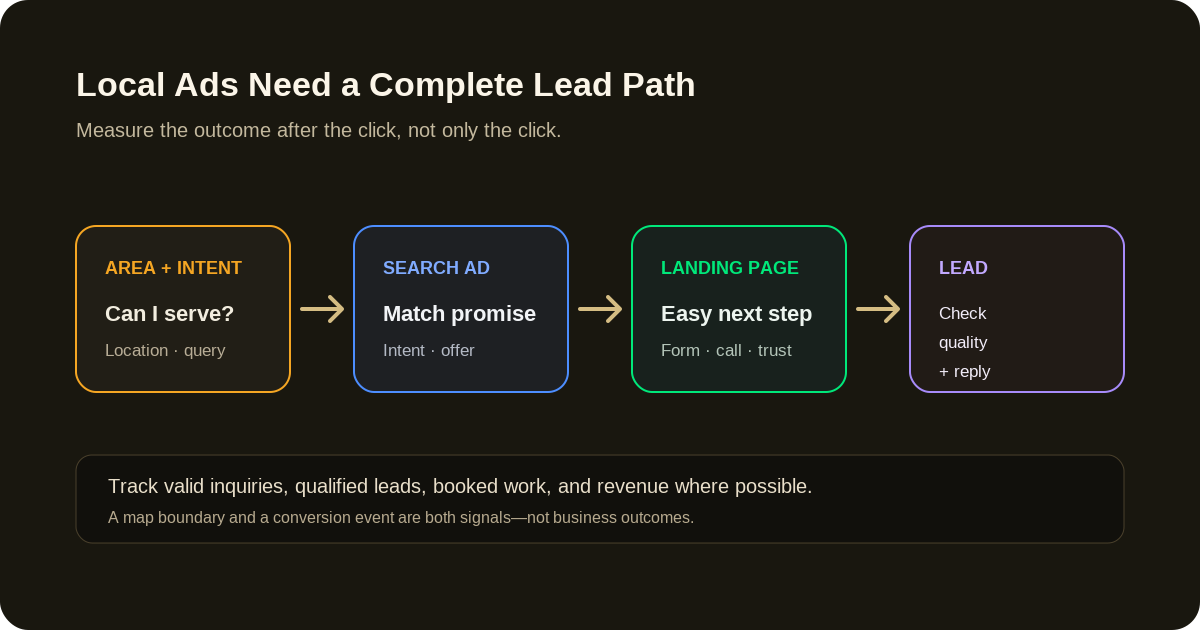
A local service business can receive clicks from the next city over and still struggle to book the right jobs. The issue may not be that the ads need more reach. The campaign may target an area the team cannot serve, use an offer that attracts the wrong requests, or count every form submission as a qualified lead.
A practical Google Ads plan begins with the business’s service capacity and customer economics. Then it connects geography, search intent, conversion measurement, the landing page, and the follow-up process. No setting guarantees profitable leads. A clear measurement loop helps you decide what to change.
How do you choose which areas to target?
Start with places you can serve profitably, then compare location settings with actual lead quality. A radius on a map is not a complete strategy. Travel time, service capacity, local demand, and the value of a job all matter.
List the cities, postal areas, or service zones the business can reliably reach. Mark areas that require travel fees, have limited availability, or are outside licensing boundaries. If appointment capacity is limited, do not target a large region simply because the platform allows it.
Google Ads’ default location options can include people likely to be in or regularly in the selected area and people who have shown interest in it. In some cases, a location-of-interest setting can reach someone searching about a place from elsewhere. Google documents this behavior and its location options. Choose a presence-focused setting if your business needs people physically in the service area; retain broader intent when remote interest is genuinely useful, such as travel or relocation services.
Use exclusions deliberately. If the team cannot serve a neighboring city, add an exclusion where appropriate and review the location report. Location signals are estimates, not a perfect boundary. Check actual inquiry addresses and call locations before claiming the targeting is precise.
A hypothetical plumber might begin with two adjacent service zones because technicians can reach both in a normal workday. After a few weeks, the owner can compare qualified inquiries and completed jobs by area. If the farther zone produces requests the team repeatedly declines, adjust it. Do not interpret this example as a performance result; the right decision depends on the local business.
Which Google Ads campaign should a local business start with?
Match the campaign to how customers seek the service and what the business can measure. Search is often a logical first test when people actively search for a service. Other campaign types can help with discovery or remarketing, but they have different intent and creative requirements.
| Campaign approach | Typical user context | Useful when | Watch for |
|---|---|---|---|
| Search | User types a query | Service has explicit search demand | Broad keywords and weak landing-page match |
| Search with call assets | User wants to contact quickly | Calls can be answered and tracked | Missed calls and low-quality call counting |
| Lead form asset | User can submit within an ad | Account and campaign are eligible | Lead delivery, privacy policy, and follow-up setup |
| Display or video | User sees an ad while browsing | Awareness or remarketing has a clear role | Treating views as immediate qualified demand |
| Performance Max | Automated placements across Google inventory | Conversion signals and assets are mature | Limited placement control and unclear lead quality |
Campaign availability and formats change. Check current account eligibility and official requirements before committing. Google’s lead form asset documentation explains eligible campaign types, privacy policy requirements, and lead-delivery options. For search network placements, see where Search ads can appear.
Avoid starting multiple campaign types at once if the account cannot distinguish which one produced a qualified lead. Keep the first test focused enough to learn.
How do you choose keywords and write ads for local intent?
Use the words a buyer uses when they need the service, then connect each ad to a page that fulfills that promise. Search terms reveal intent; broad or ambiguous traffic can consume budget without producing useful inquiries.
Separate terms by job and urgency. “Emergency boiler repair” expresses a different need from “boiler maintenance plan.” Include service and location terms where people use them naturally, but do not assume that adding every nearby city to every keyword improves quality.
Start with a manageable set:
- List the primary services and the words customers use for them.
- Separate urgent, comparison, and research intent.
- Add negative keywords for irrelevant jobs, employment searches, free instructions, or locations you do not serve, based on actual search terms.
- Write ad text that states the service, coverage, and next step accurately.
- Send each ad group to a relevant page rather than a generic homepage.
Review the search terms report and the inquiries themselves. A keyword that produces clicks can still attract the wrong service request. Ask the sales or operations team which leads were reachable, eligible, and commercially relevant.
How do you turn a click into a useful lead?
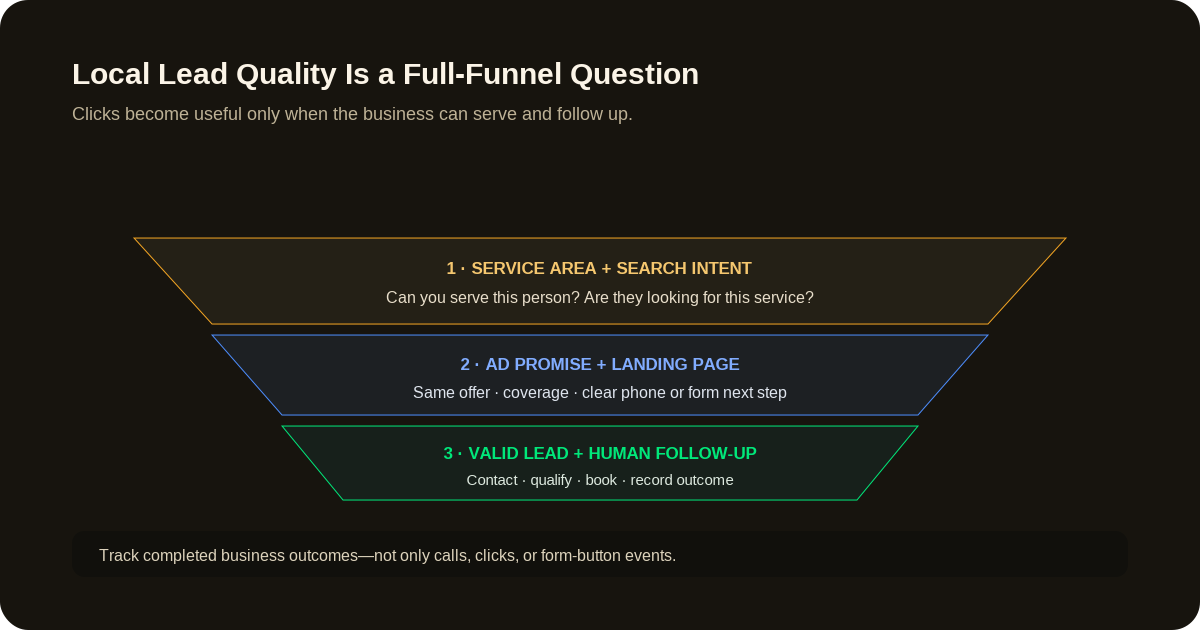
Make the landing page answer the ad’s promise and make the next step easy to complete. A local visitor wants to know what service is offered, whether the business covers their area, how to get help, and what happens after submitting a request.
Include a clear service description, real coverage information, a working phone number, an accessible form, and a realistic next-step expectation. Avoid claiming “available now” unless calls are actually answered. Keep the form as short as the business process allows, while collecting enough information to qualify and follow up.
Test the form on mobile and verify each field, validation message, thank-you state, and notification. Check that a real test lead reaches the correct inbox or CRM. A conversion tag firing on a button click is not the same as a successfully delivered lead.
For Google-hosted lead forms, confirm eligibility and data delivery. Google says forms require a privacy policy and offers options such as downloads, notifications, API, webhook, or a partner connection, depending on current setup. Do not leave leads in an export queue that nobody checks.
What should you measure before increasing spend?
Measure qualified outcomes, not just clicks or form events. Connect the website conversion to a completed, valid inquiry; then, where possible, feed back which inquiries became qualified opportunities or customers.
At minimum, monitor spend, search terms, calls, valid submissions, contact rate, qualified leads, booked work, and revenue where available. Keep conversion definitions explicit. A short call, spam form, or duplicate submission should not automatically count as a successful sale.
If a team can record lead outcomes in a CRM, use a consistent status such as new, contacted, qualified, booked, and closed-lost. Upload or connect downstream outcomes only with the appropriate account configuration, data permissions, and current platform requirements. Do not send information the business is not permitted to share.
Set a review rhythm. At first, inspect the search terms, geographic distribution, and lead handling frequently enough to catch waste. Avoid making several changes each day and then guessing which one caused the result. Keep a change log and compare periods fairly.
How do you plan an awareness campaign versus a lead campaign?
A lead campaign asks the platform to find conversion actions; an awareness campaign seeks reach or attention. A new local business may need both over time, but should not judge a reach-focused campaign solely by direct form submissions.
Use an awareness or video campaign when the objective is to introduce the business to a relevant local audience and you have a useful creative message. Use Search or a lead-focused format when the user is ready to ask or act. Define the intended outcome before launch, and use measurement that matches it.
If the business has no conversion tracking, fix measurement before asking automation to optimize for conversions. If it has only a few valid leads, avoid interpreting short-term fluctuations as certainty. The account needs enough trustworthy signal to compare options; the required volume varies by business and campaign.
For Meta campaigns, objectives and audience options differ. Our Meta lead ads and awareness guide explains how to think about those choices without treating every placement as a lead source.
What are common reasons local Google Ads leads are poor?
Poor leads often come from a mismatch between location, intent, offer, landing page, tracking, and follow-up. Check the whole journey before changing bids or expanding geography.
- Search terms attract jobs or locations the company does not handle.
- The ad promises emergency service, but no one answers after hours.
- The form accepts every region, while the campaign targets a smaller area.
- A click is counted as a conversion even if the form fails.
- The lead reaches a shared inbox that is not monitored.
- Search partner traffic is included without reviewing whether it fits the goal.
- Several campaign types are combined, obscuring what generated the inquiry.
Make one change at a time and inspect actual lead records. Protect customer information when reviewing it. A weekly report that says “30 conversions” is not useful if the business cannot identify which were valid or what happened next.
Frequently asked questions
Should I target a radius or specific cities?
Use the smallest geography that matches service capacity and customer demand. Compare actual inquiry quality by area; do not rely on a map radius alone.
Should Google Ads target people interested in my location?
That depends on the service. It can suit travel or relocation intent. A business requiring physical presence may prefer presence-focused settings and should inspect location reports.
Can Google Ads collect leads inside the ad?
Eligible accounts and campaigns can use lead form assets. Check current requirements, privacy policy, delivery, and follow-up settings.
Is a form submission a qualified lead?
Not automatically. Verify that it is valid, reachable, in the service area, and relevant to the offer.
Should I send every local campaign to my homepage?
Usually, a service-specific page is easier to align with a specific ad. It should explain the offer and make the next step clear.
How quickly should I judge a campaign?
Use enough time to collect meaningful and verified outcomes. The timeframe depends on traffic, conversion volume, sales cycle, and budget. Avoid promising a universal learning period.